
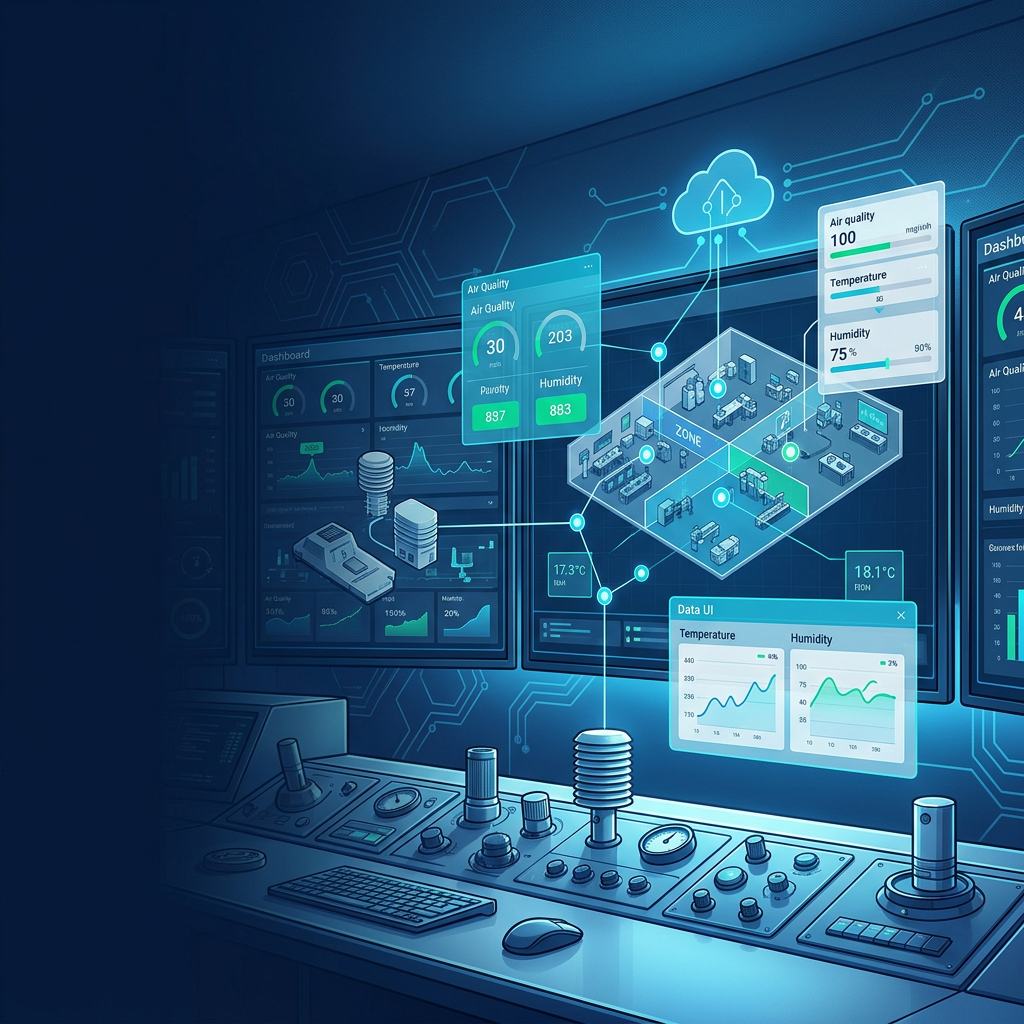
Source : AI Generated Image
Operating multiple industrial facilities often means dealing with data spread across different locations. You need a reliable multi-site environmental monitoring platform to bring this data together. This system helps you reduce operational downtime. Without the right tools, multi-site environmental monitoring turns into a massive headache. Undetected climate shifts can quickly escalate into costly production delays.
Real-Time Environmental Monitoring can drastically improve data accuracy and efficiency. Implementing Real-Time Environmental Monitoring allows businesses to respond to environmental changes swiftly.
Historically, managers relied on a patchwork of isolated devices. Today, an industrial environmental monitoring platform connects everything seamlessly. By adopting centralized monitoring software, teams gain complete visibility from a single screen. This makes real-time environmental monitoring a core part of daily operations. It keeps your facilities safe, compliant, and highly efficient.
Quick Summary
- Transitioning from isolated tools to a unified ecosystem
- How interconnected systems improve operational resilience
- The role of smart infrastructure in modern management
- Key parameters and hardware for connected workplaces
What Is Real-Time Environmental Monitoring?
It is the continuous process of tracking climate and air quality metrics across facilities. This approach uses connected sensors to feed live data into a single system. It ensures safety and operational efficiency at all times.
Managers need an environmental monitoring system to stay informed. Single platform monitoring lets you oversee operations without travelling. A robust multi-location monitoring solution replaces manual checks with automated precision.
Understanding Real-Time Environmental Monitoring is essential for modern facility management. Real-Time Environmental Monitoring maximizes safety and operational efficiency through live data tracking. With Real-Time Environmental Monitoring, you gain insights that drive data-informed decisions.
Defining the Smart Industrial Ecosystem
Real-Time Environmental Monitoring integrates seamlessly into your existing infrastructure. Utilizing Real-Time Environmental Monitoring can help prevent potential issues before they arise. Real-Time Environmental Monitoring ensures compliance with health and safety regulations.
A smart ecosystem moves away from standalone devices. It embraces connected networks instead. You integrate climate controls, laboratory equipment, and lighting into a cloud-based monitoring platform. This gives facility managers complete operational oversight. Using Internet of Things (IoT) environmental sensors ensures cross-device accessibility. Teams can review data from their smartphones anywhere in the world. This industrial IoT monitoring framework turns reactive maintenance into a proactive strategy.
Incorporating Real-Time Environmental Monitoring can enhance your operational resilience. Real-Time Environmental Monitoring empowers teams with data-driven insights.
Using Real-Time Environmental Monitoring technology can significantly reduce risks. Real-Time Environmental Monitoring is critical for maintaining cleanroom integrity. With Real-Time Environmental Monitoring, you can identify operational trends effectively. Real-Time Environmental Monitoring supports proactive maintenance efforts across facilities.
Think of it like a central nervous system for your facilities, where remote environmental monitoring acts as the nerve endings reporting back to one main brain.
Investing in Real-Time Environmental Monitoring enhances your overall operational efficiency.
Key Environmental Parameters to Track
- Air quality metrics: Track Particulate Matter 2.5 (PM2.5), Carbon Dioxide (CO2), and Total Volatile Organic Compounds (TVOC) to protect cleanroom integrity.
- Temperature and humidity: Ensure controlled environments remain stable with precise temperature humidity monitoring.
- Electromagnetic radiation: Monitor ambient noise and radiation levels to protect worker health in active zones.
Real-Time Environmental Monitoring is essential for comprehensive environmental compliance.
Real-Time Environmental Monitoring systems ensure data integrity and reliability.
Why Centralised Multi-Site Monitoring Matters
Incorporating Real-Time Environmental Monitoring into your strategy can drive innovation.
Centralised oversight eliminates blind spots by consolidating data from different geographical locations. It allows managers to spot trends early. You can resolve issues long before they cause expensive downtime.
Reducing Operational Downtime and Risks
Real-Time Environmental Monitoring enhances operational visibility across multiple sites. Utilizing Real-Time Environmental Monitoring can significantly optimize resource management. Real-Time Environmental Monitoring is the future of industrial data management. Implementing Real-Time Environmental Monitoring can streamline your compliance processes. Real-Time Environmental Monitoring solutions drive operational excellence.
Employing Real-Time Environmental Monitoring systems leads to better decision-making in operations. Real-Time Environmental Monitoring is key to adaptive industrial strategies. Ultimately, Real-Time Environmental Monitoring enhances the sustainability of operations.
Fragmented data slows down your decision making. A multi-facility monitoring system provides instant alerts. These alerts prevent minor climate deviations from escalating into major faults. This continuous visibility means engineers can implement proactive maintenance. They base these decisions on real-time sensor data. Companies save on repair costs and avoid unexpected production halts. Using wireless environmental sensors makes this continuous coverage highly adaptable to changing layouts.
Streamlining Health and Safety Compliance
Meeting strict regulatory standards requires meticulous environmental data management. A centralised approach simplifies this task entirely. It provides automated data logging for regulatory audits. It also aids in Good Practice (GxP) environmental monitoring. This ensures sensitive pharmaceutical or food production areas remain compliant. Relying on enterprise monitoring software streamlines your environmental compliance monitoring. Teams no longer need to sort through disorganised spreadsheets.
A major pitfall teams encounter is relying on manual data collection. This often leads to human error during crucial industrial compliance reporting audits.
Core Components for Connected Workplaces
A connected workplace relies on commercial-grade sensors, reliable network gateways, and a centralised dashboard. Together, these elements capture, transmit, and display critical facility data seamlessly.
Smart Sensors and Industrial Hardware
Accurate data starts with high-quality commercial-grade monitors like the Tongdy EM21 Series. These units offer multi-parameter environmental monitoring. They track everything from particulate matter to ambient light. For highly regulated zones, integrating precision measurement tools is vital. You should use reliable backup instruments alongside digital tools. Placing a battery-free Brannan Horizontal Thermometer inside a critical chiller provides a fail-safe analogue check next to your digital environmental monitoring dashboard.
Network Gateways and Data Transmission
- Connectivity options: Leverage Wi-Fi, Ethernet, and LoRa industrial sensors to ensure uninterrupted data flow from sensor to server.
- Legacy integration: Use serial communication protocols to link older industrial sensor integration hardware with modern networks.
- Data preservation: Utilise sensors with local data loggers that temporarily store readings if the connection drops.
Advanced commercial units functioning as a complete CO2 monitoring system can temporarily store over 140,000 data points locally. This ensures zero data loss across your scalable monitoring platform during network disruptions.
Cloud Platforms vs Local Servers: Which Wins?
Cloud platforms generally win for multi-site operations due to their scalability and global accessibility. Local servers are better suited for facilities with strict, air-gapped security policies.
Comparing Data Storage Infrastructure
| Feature | Cloud Platforms | Local Servers | Best For |
|---|---|---|---|
| Scalability | Easily expands across borders via a Software as a Service (SaaS) monitoring solution | Requires manual hardware upgrades | Growing multi-site operations |
| Maintenance Costs | Lower upfront costs and managed remotely | High maintenance associated with an on-premise monitoring software setup | Budget-conscious facilities |
| Deployment Speed | Rapid rollout across a telemetry data platform | Slow rollout requiring physical installation | Fast-moving enterprise networks |
Security and Remote Access Considerations
Accessing a role-based monitoring dashboard via smartphones gives authorised personnel immediate control. Security is paramount when dealing with sensitive industrial data acquisition. Systems must use encrypted monitoring data protocols. This prevents unauthorised access during transmission. Whether using a cloud setup or local servers, strict access control is necessary. It ensures only approved staff can adjust environmental alarm notifications.
Imagine receiving an automated mobile alert about a pressure drop in an offshore facility. This allows you to adjust the differential pressure monitoring system remotely before contamination occurs.
Step-by-Step Implementation for Your Sites
Deploying a unified system involves auditing your facility needs, installing calibrated hardware, and configuring your software interface. A phased rollout ensures minimal disruption to daily operations.
Step 1: Audit Your Site Requirements
Begin by identifying critical environmental parameters for each specific facility. Assess your existing network infrastructure. Look for blind spots where a manufacturing facility monitoring setup might struggle with connectivity. Determine the specific compliance requirements for different zones. For example, you might need Food and Drug Administration (FDA) 21 CFR Part 11 monitoring for pharmaceutical areas.
Step 2: Deploy and Calibrate Sensors
Position your hardware carefully for accurate environmental compensation. This supports reliable automated environmental monitoring. Integrate commercial units into your existing Heating, Ventilation, and Air Conditioning (HVAC) systems. Establish a baseline calibration schedule. This ensures your warehouse environmental monitoring remains accurate over time. It directly supports your predictive maintenance monitoring efforts.
Step 3: Configure Cloud Dashboards
Map your data points to specific geographical locations within your energy monitoring platform. Set up environmental threshold alerts for mobile notifications. This helps teams react instantly to any anomalies. Finally, train your personnel on remote system management. They must confidently use the regulatory compliance monitoring tools daily.
Start your rollout in a single, non-critical zone. This tests network stability before scaling a cleanroom monitoring system across the entire facility.
Build a Smarter, Safer Industrial Ecosystem
Unified technology platforms maintain optimal workplace conditions by connecting all your critical data. Partnering with a holistic solutions provider ensures you build a resilient and scalable infrastructure.
Centralised monitoring eliminates operational blind spots. It provides the scalability growing enterprises need. Integrating health, safety, and performance data into a unified monitoring platform drives better decisions. GMM Technoworld Pte Ltd offers a comprehensive Environmental Detecting System Solutions (EDSS) ecosystem. It connects climate controls, lab equipment, and data servers seamlessly.
This holistic approach replaces fragmented tools with a robust environmental monitoring software framework. As Artificial Intelligence (AI) integration evolves, factory environmental monitoring will become even more automated. A high-quality air quality monitoring system is no longer optional. For businesses needing reliable environmental monitoring Singapore solutions, unified platforms offer unmatched environmental risk management. Contact GMM Technoworld today to design a custom continuous environmental monitoring solution that protects your workforce.
Frequently Asked Questions
Can I monitor multiple sites from a single dashboard?
Yes, you can. Cloud-based platforms consolidate data from different geographical locations into one interface. This allows facility managers to oversee all operations remotely.
What happens if the network connection drops?
Usually, local data loggers store the readings temporarily. Once the connection is restored, the sensors automatically upload the backlogged data to the cloud.
Are commercial sensors hard to install?
No, they are straightforward to deploy. Modern sensors offer flexible mounting options and connect via Wi-Fi or LoRaWAN. This reduces the need for complex wiring in existing facilities.
How often should industrial sensors be calibrated?
It depends on your specific environment. Most environmental sensors require annual calibration to maintain accuracy. Harsh industrial conditions might necessitate more frequent maintenance checks.