
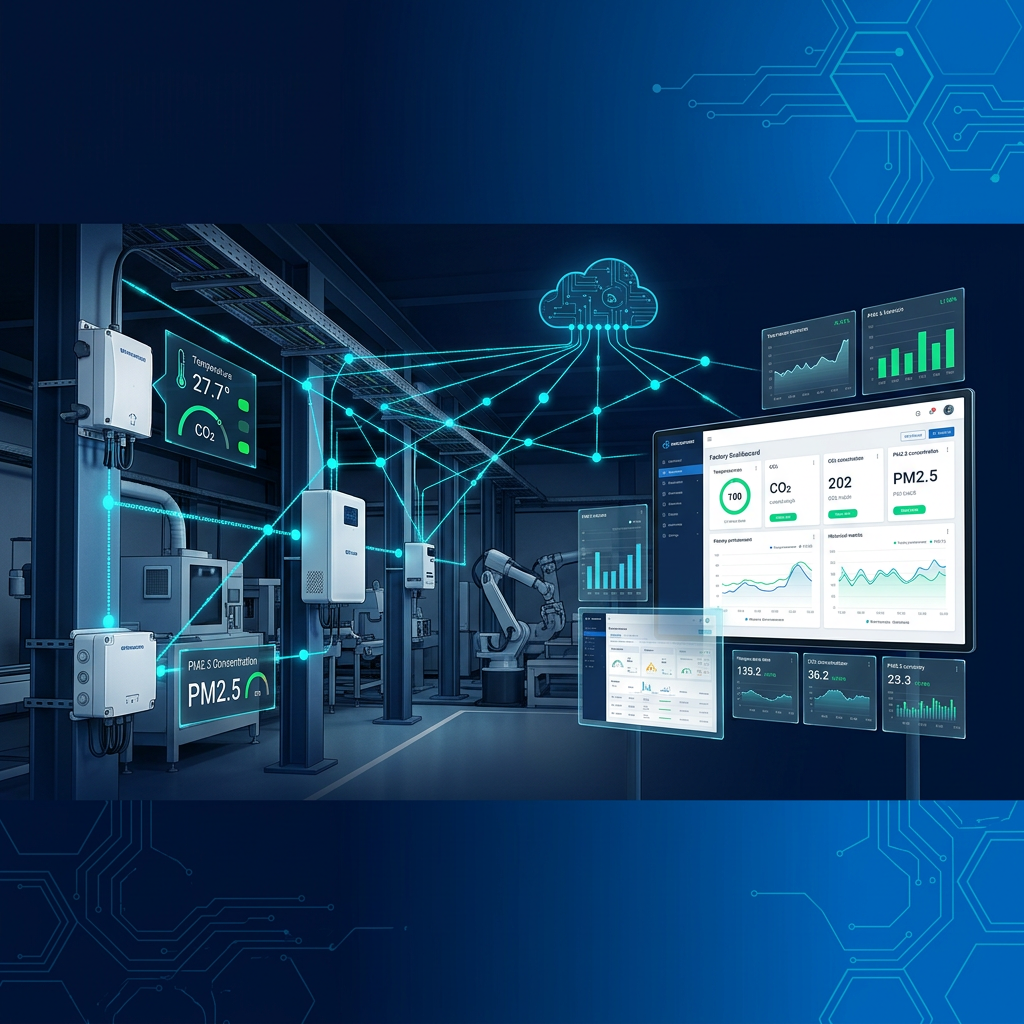

Source : AI Generated Image
Alt Text : Top Features to Compare in Industrial IoT Environmental Monitoring Platforms for Singapore Manufacturers
The shift from analogue tracking to smart digital infrastructure is reshaping factory floors. When conducting an industrial IoT environmental monitoring platform comparison, facility managers must look beyond basic tools. This guide explores how an integrated ecosystem outshines standalone sensors. We will look at connectivity, precision, and scaling factors. Real-time data has a huge impact on operational resilience.
Quick Summary
- Shift from manual tracking to a smart factory environmental sensor network.
- Why ecosystem integration is better than standalone devices.
- The role of accurate indoor air quality monitoring.
- How to choose the right connectivity and IoT platform data storage.
- Selecting a holistic partner like GMM Technoworld Pte Ltd.
What Are Industrial IoT Environmental Monitoring Platforms?
These platforms are integrated networks of smart sensors that collect real-time data on air quality, temperature, and equipment health. They centralise this information to help facility managers optimise industrial operations remotely.
The reality is that isolated tools are no longer enough. A modern industrial sensor monitoring system connects every part of your building. This creates a reliable industrial wireless sensor network where data flows smoothly. Facility teams can spot problems before they cause delays.
An effective device management IoT platform saves hours of manual checking by pushing automatic updates straight to your dashboard.
Defining the Core System Architecture
At the foundation, you have edge devices, gateways, and servers working together. The architecture replaces isolated measurement tools with interconnected nodes. For example, a multi-sensor IoT node gathers data locally. Then, an edge computing IoT platform processes this information quickly before sending it upwards.
Platforms like the Environmental Detecting System Solutions (EDSS) from GMM Technoworld unify these nodes. This setup forms a comprehensive IoT platform for manufacturers. It ensures you have total visibility over your facility at all times.
Understanding the Role of Cloud Connectivity
Cloud connectivity changes how teams manage large facilities. It eliminates the need for manual on-site data collection. Managers gain instant access via smartphones and laptops from anywhere in the world. This remote oversight keeps production lines running without constant physical inspections.
- Remote access: Check your factory floor monitoring system from your mobile phone.
- Centralised streams: Bring all remote monitoring industrial IoT data into one hub.
- Real-time analysis: Use a sensor data visualization tool to spot trends instantly.
Why Do Singapore Manufacturers Need Smart IoT Systems?
Manufacturers need these systems to prevent costly downtime and meet strict sustainability rules. Smart systems automate tracking, ensuring both equipment and air quality remain within safe limits.
For any Singapore manufacturing IoT strategy, compliance and efficiency are top priorities. The right Industry 4.0 platform Singapore relies on helps businesses adapt to fast-changing regulations. Staying ahead of these rules prevents expensive fines.
Predictive maintenance powered by IoT can reduce unplanned machine downtime by up to 50 percent, saving thousands of dollars per minute.
Meeting Strict Green Building Standards
Singapore has tough targets for sustainability. Meeting these goals requires precise environmental monitoring platform features. Facilities must track specific pollutants to pass WELL V2 and Leadership in Energy and Environmental Design (LEED) V4 assessments.
This is where tools like the Tongdy EM21 Series come in. It is a commercial-grade monitor perfect for manufacturing compliance monitoring. It measures Particulate Matter 2.5 (PM2.5), Carbon Dioxide (CO2), and Total Volatile Organic Compounds (TVOC). Reliable CO2 monitoring industrial IoT tools ensure your building stays green and compliant.
Preventing Costly Operational Downtime
Unplanned factory stops cost money. Finding climate control failures early stops small issues from becoming major disasters. A strong predictive maintenance IoT setup protects sensitive laboratory and industrial equipment. This prevents product spoilage and equipment damage.
- Early detection: Finding climate control failures before they escalate.
- Asset protection: Shielding sensitive laboratory and industrial equipment.
- Shift in strategy: Moving from reactive repairs to proactive management.
Having a reliable temperature humidity monitoring IoT system alerts you before a critical chiller fails. You avoid massive losses by acting on the data immediately.
Which Core Features Should You Compare in IoT Platforms?
You should compare sensor accuracy, system integration, and alert functions. A reliable platform needs automated calibration, versatile communication protocols, and customisable notifications.
Finding the best fit means looking closely at the details. A proper cloud IoT platform comparison must weigh technical specs against practical use. It is important to know exactly what your facility requires before buying.
Sensor Precision and Automated Calibration
Accurate data dictates platform reliability. You need a system with built-in environment compensation algorithms. This ensures industrial air quality monitoring remains precise over time. Using an NB-IoT environmental sensor offers low power usage without losing accuracy.
Comparing laser particle sensors with standard optical ones shows a clear difference. Laser sensors offer the exactness needed for strict certifications. A high-quality VOC sensor industrial platform relies on this precision to keep workers safe.
| Feature | Laser Particle Sensors | Standard Optical Sensors | Impact on Compliance |
|---|---|---|---|
| Accuracy Level | Highly accurate commercial grade | Basic general measurement | Essential for LEED |
| Pollutant Tracking | Precise PM2.5 and PM10 | Broad dust detection | Meets strict safety standards |
Seamless Integration with Legacy Systems
New technology must work with your old equipment. When evaluating IoT platform integration capabilities, look for flexible connectivity. This prevents vendor lock-in and saves money.
You will want protocols like RS485 Modbus RTU and Long Range Wide Area Network (LoRaWAN). A robust Modbus protocol IoT gateway connects smoothly to existing Heating, Ventilation, and Air Conditioning (HVAC) controls. Additionally, LoRaWAN industrial monitoring helps cover large areas without heavy wiring. Proper SCADA IoT integration ensures your old supervisory systems talk to new sensors.
Real-Time Alerts and Proactive Maintenance
Health and safety officers need to act instantly. Configuring threshold-based push notifications is vital for real-time environmental monitoring. This setup sends an alert the moment something goes wrong.
- Custom alerts: Configuring threshold-based push notifications.
- Visual cues: Using Light Emitting Diode (LED) indicators for immediate at-a-glance status.
- Quick response: Empowering health and safety officers to act instantly.
Whether you are using a basic setup or an advanced energy monitoring IoT platform, immediate alerts save time. These features prevent small errors from turning into large accidents.
Cloud vs Local Data Storage: Which Wins for Facilities?
Cloud storage wins for large operations needing remote access across multiple sites. Local storage is only better for highly sensitive, air-gapped legacy systems that cannot connect to the internet.
Data storage is a major factor in IoT platform deployment cost. You must decide where your critical information lives. Choosing the right storage setup determines how fast you can respond to emergencies.
Analysing Remote Data Accessibility
Isolated local storage has limits. If you manage multiple sites, you cannot physically be everywhere. The advantage of cloud solutions is multi-site oversight from one screen.
| Feature | Cloud Data Storage | Local Data Storage | Best For |
|---|---|---|---|
| Access | Remote via mobile app | On-site physical access only | Cloud wins for multi-site |
| Scaling | Easy automated growth | Requires new hard drives | Cloud wins for expansion |
| Setup | Supports external connections | Standalone setup | Cloud wins for modern systems |
Looking at cloud vs edge IoT processing, the cloud offers better long-term flexibility. Mobile app integration changes how facility management works daily. Smooth third party system integration IoT allows your new tools to sync easily.
Evaluating Platform Security Protocols
Some managers worry about cloud vulnerabilities. However, leading industrial platforms use strong IoT platform security features. Encrypted data transmission protects your network from outside threats.
Ignoring basic corporate Information Technology (IT) security standards when setting up cloud access leaves your network open to outside threats.
Using a secure data encryption IoT platform ensures you meet corporate IT standards. Whether you use a Google Cloud IoT platform, or weigh AWS IoT vs Azure IoT, security is usually built right in.
How to Select the Right IoT Partner for Your Operations?
Choose a partner that offers both durable hardware and scalable software. Look for experts who understand ecosystem integration rather than just selling standalone devices.
The market is full of options. Reading an IoT platform vendor comparison helps, but you need a strategic partner. GMM Technoworld stands out because they provide an ecosystem-driven approach.
Reviewing Hardware and Sensor Reliability
High-tech software needs strong hardware. Ensure devices have the right Ingress Protection (IP) ratings and fireproof shells. A reliable OT IT integration platform bridges physical tools with digital networks smoothly.
- Digital tools: Selecting partners with smart software.
- Physical hardware: Ensuring devices have appropriate IP ratings and fireproof shells.
- Analogue backups: Using Brannan thermometers for specific chillers.
It is also smart to balance digital tools with analogue backups. For instance, using a Brannan Horizontal Fridge or Freezer Thermometer in a critical chiller provides a fail-safe. If the power drops, this kerosene-filled thermometer keeps working. It is a simple way to maintain IoT platform uptime reliability during emergencies.
Assessing Long-Term Ecosystem Scalability
Your facility will grow. You need an IoT platform scalability plan that grows with you. Partnering with a comprehensive provider like GMM Technoworld ensures you are ready for the future. A powerful data analytics IoT platform helps you spot long-term trends.
You might start with basic sensors and later add Electromagnetic Radiation (EMR) protection or Negative Air Ion (NAI) technology. A digital twin manufacturing Singapore setup might be your next step. Choosing a flexible, perhaps even a no-code IoT platform, makes adding modules easy. Even an IoT platform for SMEs can scale up quickly if built right.
Relying on a rigid OPC UA industrial platform without checking future expansion costs often leads to expensive system overhauls later.
Finally, check the IoT dashboard visualization tools. They should be clear and easy to read. A transparent IoT platform pricing comparison will show you the true cost of scaling over time.
Future-Proof Your Facility with Smart IoT Integration
Upgrading your facility means moving away from isolated tools. An integrated ecosystem provides the visibility needed to keep operations running smoothly.
Integrated platforms offer superior oversight compared to standalone sensors. Cloud connectivity is now essential for managing any modern building remotely. As green building standards tighten across Singapore, early adoption of comprehensive IoT monitoring will become a huge advantage.
Choosing a holistic technology partner ensures your setup scales without issues. If you want to check IoT environmental monitoring Singapore options, look for proven solutions. Contact GMM Technoworld today to explore how the EDSS platform can transform your industrial environment into a smart, resilient ecosystem. You can easily find the best IoT platform 2025 has to offer by looking at their integrated approach.
Frequently Asked Questions
What are industrial IoT environmental monitoring platforms?
They are integrated networks of smart sensors. These platforms collect real-time data on temperature, air quality, and equipment health to optimise facility operations remotely.
How do IoT platforms improve factory energy efficiency?
They identify energy waste by tracking usage patterns in real time. This data allows facility managers to adjust climate controls instantly, reducing overall operational costs.
Can wireless IoT sensors integrate with legacy systems?
Usually. High-quality IoT platforms use versatile communication protocols like RS485 and Modbus RTU to connect seamlessly with older building management systems.
Why is cloud connectivity important for facility managers?
It provides secure, remote access to critical facility data. Managers can monitor conditions, receive instant alerts, and oversee multiple sites from any smartphone or laptop.
Are IoT monitoring platforms secure against data breaches?
Yes. Leading industrial platforms utilise advanced data encryption and secure cloud protocols. This protects sensitive operational data and ensures compliance with corporate IT security standards.